 Travel Guide
Meghalaya Trip Cost from Bangalore: 5-Day Guide (2026)
Plan your Meghalaya trip cost from Bangalore with a 5-day itinerary covering flights, stays, meals and transfers. Explore the full itinerary and enquire today.
Read Article
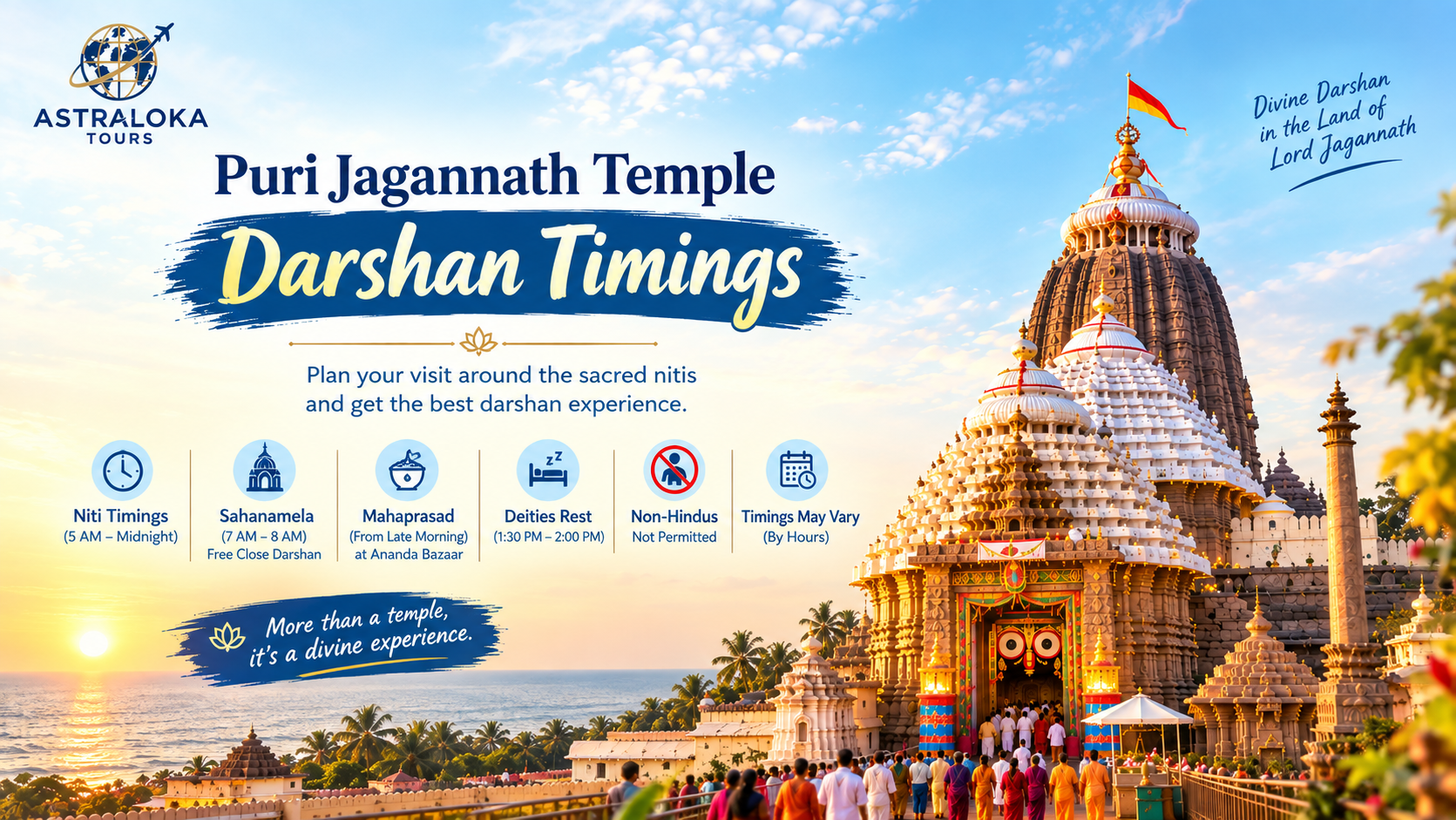
The temple runs on nitis, not on opening hours, and the difference decides what you actually see. Here are the Puri Jagannath temple darshan timings laid out ritual by ritual, including the free hour most visitors miss.
The temple does not have opening hours in the way a museum does. It has nitis, a chain of rituals that starts before dawn and ends at midnight, and our Odisha tour packages are built around them.
Understanding the Puri Jagannath temple darshan timings means understanding that chain. Miss the right hour and you will see the deities from a distance instead of up close.
The temple opens with Dwaraphita at 5:00 am and closes after Pahuda around midnight. Between those two points sit roughly fifteen nitis, and the Puri Jagannath temple darshan timings are really a list of which of those you may attend.
The Odisha government’s own review of the temple confirms that the nitis run daily from 5 am to midnight and sets out the prescribed hour for each one.
| Time | Niti | What it means for you |
|---|---|---|
| 5:00 am | Dwaraphita and Mangal Alati | Doors open, first lamp offering |
| 6:00 am | Mailam | Night dress removed, no public access |
| 6:00 to 6:30 am | Abakash | Ritual bathing of the deities |
| 7:00 to 8:00 am | Sahanamela | Free close darshan at the Ratna Vedi |
| 9:00 am | Gopala Ballav Bhoga | Breakfast offering |
| 10:00 am | Sakal Dhupa | Morning meal, Mahaprasad follows |
| 11:00 am | Bhoga Mandap | Large public bhoga prepared |
| 1:00 pm | Dwiprahara Dhupa | Midday meal offering |
| 1:30 to 2:00 pm | Madhyan Pahuda | Deities rest, two gates close |
| 8:00 pm | Sandhya Dhupa | Evening meal offering |
| 11:00 pm | Badasinghara Dhupa | Last offering of the day |
| Midnight | Khata Sejulagi and Pahuda | Deities retire, temple sealed |
Sahanamela is the one hour each day when the public may approach the Ratna Vedi closely, free of charge. It normally runs from 7:00 to 8:00 am and is the single most valuable slot in the Puri Jagannath temple darshan timings.
For the rest of the day you view the deities from further back, through the Jagamohana or the Nata Mandir. During Sahanamela you get near, though you may not touch them.
On heavy days the temple sometimes extends the hour. On certain festival days it is granted a second time, after Sandhya Alati.
There is a second reason to care. Sakal Dhupa at around 10:00 am is when the Mahaprasad cooked in the temple kitchen is offered and then re offered at the shrine of Goddess Bimala, which is the point at which it becomes Mahaprasad proper. Timing your morning well lets you catch both.
Plan your morning around it rather than around the 5:00 am opening. Arriving at five gets you into the complex, not to the front of the Ratna Vedi. Pilgrims on our Puri Jagannath 1N/2D itinerary are at the gate before six for exactly this reason.
Because each niti depends on the one before it, and each needs specific hereditary servitors present. If one is delayed, everything behind it shifts. This is not a rumour among pilgrims; it is stated plainly in the state government’s own account of the rituals.
Around 119 categories of sevakas perform the daily rites, a system traced to the thirteenth century under the Ganga king Anangabhima Deva. Coordinating that many people to a clock was never realistic.
This is the difference between the Puri Jagannath temple darshan timings and the opening hours of an ordinary monument. The schedule describes an intention, and the sevakas follow the ritual rather than the intention.
Two consequences for your planning:
The Puri Jagannath temple darshan timings are a framework, not a timetable. Pilgrims who understand that leave satisfied; those who arrive with a stopwatch usually do not.
No. Entry is restricted to Hindus, and the rule is enforced at the gates. This has been the practice for centuries and applies regardless of nationality.
The question comes up constantly online: can non Hindus enter Jagannath temple if they are respectful, or travelling with Hindu family? The answer is no, and there is no tourist exception.
Settle it before anyone books a flight rather than at the entrance. It is the most common reason a Puri visit goes wrong for a mixed group.
Visitors who cannot enter still have options, and the Puri Jagannath temple darshan timings matter less for them than the Rath Yatra calendar does.
The roof of the Raghunandan Library opposite offers a clear view across the complex and its four gates. The Grand Road outside is worth walking in its own right, particularly in the early evening.
During Rath Yatra the deities are brought out to the chariots, and that procession is open to everyone regardless of faith. For a mixed group it is by far the best week to come.
If part of your group is affected, plan the morning so nobody is left waiting at the gate with nothing to do.
Dress traditionally, leave phones and leather outside, and go early. These rules are enforced more strictly here than at most Indian temples.
Knowing the Puri Jagannath temple darshan timings will not help you if you are turned back at the gate over a pair of shoes or a camera.
A few details that catch people out:
A good Puri Jagannath tour package from Bangalore will already account for these rules, the darshan hour and the dress code, which saves a lot of improvising on the morning itself.
Most visitors pair the temple with Konark and Chilika rather than treating it as a standalone stop. If your dates fall near the chariot festival, read our guide to the Puri Jagannath Rath Yatra before booking anything, because the whole town changes that week.
Decide which morning you want Sahanamela, then build the rest around it. Our Puri Jagannath 2N/3D package works backwards from the Puri Jagannath temple darshan timings so the hotel, the transfers and the Konark day all fall into place.
Send us your travel window and we will check it against the temple calendar first, including Ekadashi dates and any festival that shifts the running order.
Everything you need to know before you travel with Astraloka Tours.
The Jagannath temple opening time is 5:00 am with the Dwaraphita ritual, followed immediately by Mangal Alati. The temple closes around midnight after Pahuda.
Sahanamela, between 7:00 and 8:00 am. It is free and allows the closest approach to the Ratna Vedi of any slot in the day.
No ticket is needed to enter, and both general darshan and Sahanamela are free. Some paid closer darshan arrangements exist at certain hours.
Briefly. The deities take Madhyan Pahuda, a midday rest, roughly between 1:30 pm and 2:00 pm, when the Jaya Bijaya and Beheran gates are shut.
No, the rituals are sequential and depend on specific servitors, so delays are common and officially acknowledged. Treat every published time as approximate.
Only if they are Hindu. Others can view the complex from the Raghunandan Library roof opposite, or see the deities during the Rath Yatra procession.
Travel Guide
Plan your Meghalaya trip cost from Bangalore with a 5-day itinerary covering flights, stays, meals and transfers. Explore the full itinerary and enquire today.
Read Article Pilgrimage
lan the Vaishno Devi Amritsar tour package from Bangalore: 3 nights, flights, pure-veg meals and a day-wise itinerary. Check the details and enquire today.
Read Article Travel Guide
Work out your Puri Jagannath trip cost from Bangalore: flights, stays, cabs and tickets, with DIY totals beside our 2N/3D package from ₹31,999. See the numbers.
Read ArticleShare your travel dreams with us and we'll turn them into a perfectly planned journey.
Share your details & our travel expert will call you back within 24 hours.