 Travel Guide
Meghalaya Trip Cost from Bangalore: 5-Day Guide (2026)
Plan your Meghalaya trip cost from Bangalore with a 5-day itinerary covering flights, stays, meals and transfers. Explore the full itinerary and enquire today.
Read Article
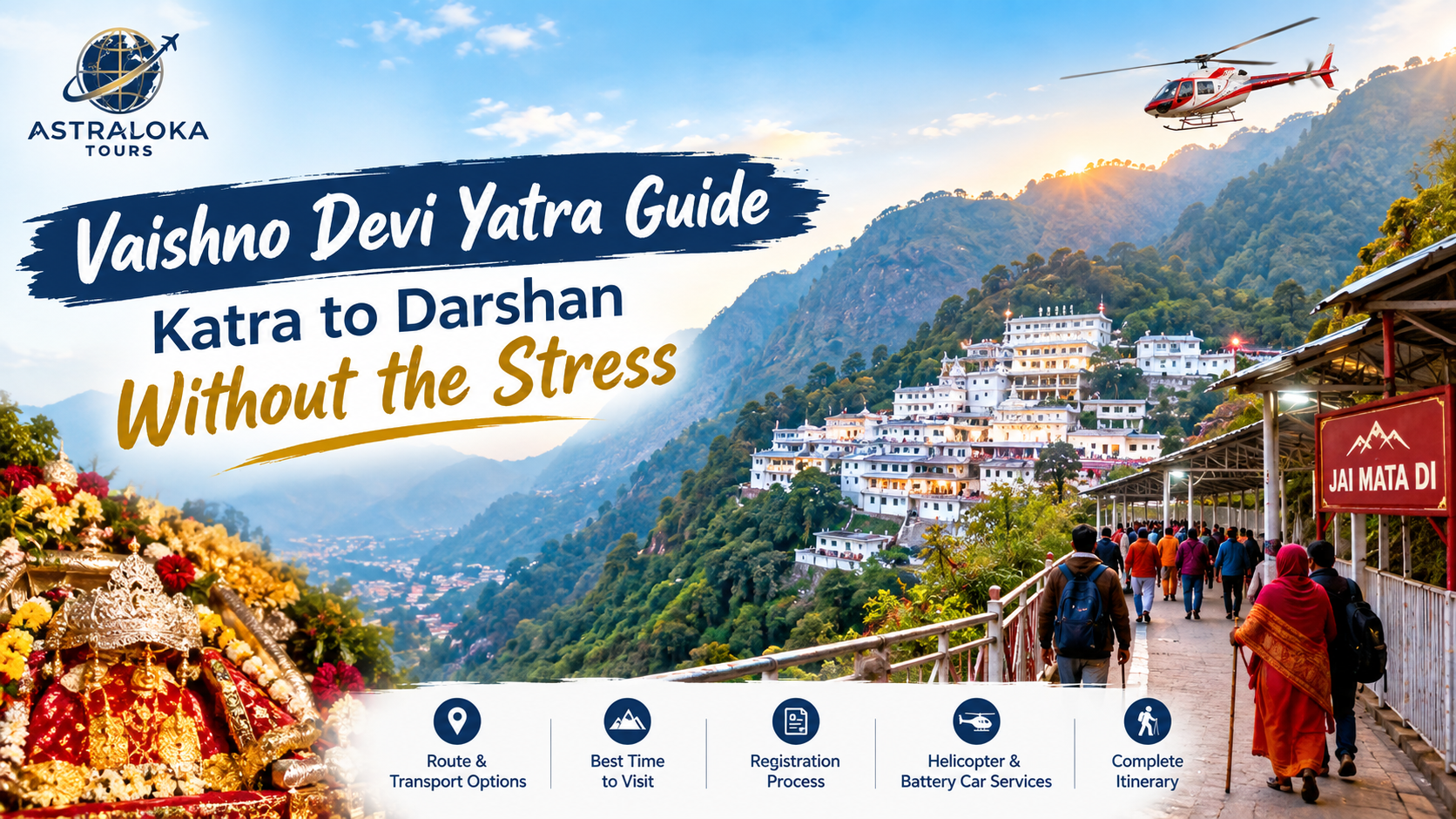
This Vaishno Devi yatra guide walks you from Katra to the holy cave: the 13 km route, the helicopter and battery car shortcuts, the RFID card rules, the best months to go and a simple three-day plan for pilgrims flying in from Bengaluru.
Nearly 95 lakh pilgrims visited the Vaishno Devi shrine in 2024, and those who struggle usually lose time to small slips: the wrong track, a missed helicopter slot or an RFID card collected too early. Still choosing dates? Our Jammu and Kashmir tours show how Bengaluru pilgrims fit the trip into three days.
This Vaishno Devi yatra guide covers the route, the four ways up, the best months, the registration rules and a realistic plan, so your energy goes into darshan rather than logistics.
Any Vaishno Devi yatra guide has to start with the climb itself. The track runs 13 km from Katra to the holy cave at the Bhawan, rising about 2,700 ft on paved paths and steps lined with shelters, food stalls and toilets. Fit walkers take five to six hours to go up.
The Shrine Board’s distance and altitude chart marks the stops that shape your day:
| Stop | Distance from Katra | Altitude | Why it matters |
|---|---|---|---|
| Banganga | 1 km | 2,800 ft | First checkpoint, where RFID cards are scanned |
| Charan Paduka | 2.5 km | 3,380 ft | Shrine marking the goddess’s footprints |
| Adhkuwari | 6 km | 4,800 ft | Halfway cave temple and battery car point |
| Himkoti | 8.5 km | 5,120 ft | Viewpoint on the gentler alternate track |
| Bhawan | 13 km | 5,200 ft | The holy cave and its three Pindis |
| Bhairon Ghati | 14.5 km | 6,619 ft | Bhairon Nath temple, by ropeway or on foot |
From Adhkuwari you pick one of two tracks. The old track climbs steeply past Hathimatha and Sanjichhat. The alternate track, opened in 1999, is wider, gentler and about 500 m shorter, keeps ponies out and carries the battery cars.
Go between March and June or between September and November, when days are mild and the track is dry. Skip July and August unless your dates are flexible, because heavy rain brings landslide warnings, and pack proper woollens for December to February.
Crowds matter as much as weather. Shrine Board figures show June 2026 drew more than 13 lakh pilgrims, roughly three times February’s 4.45 lakh, so this Vaishno Devi yatra guide leans towards November for clear skies and shorter queues.
Combining the trip with Srinagar or Gulmarg? Our season-by-season guide to Kashmir shows which months suit both halves of the journey.
Fly to Jammu, then drive to Katra. A few direct flights a week link Bengaluru and Jammu in about three and a half hours, and on other days you connect through Delhi. From Jammu airport, Katra is about 50 km away, roughly a 90-minute to two-hour taxi ride.
The practical answer to how to reach Vaishno Devi from Bangalore depends on your group, your budget and your time:
Whichever route you choose, this Vaishno Devi yatra guide assumes a rest night in Katra before the climb. Starting 13 km uphill straight off a flight leaves most people exhausted before they reach Adhkuwari.
Walk if everyone is fit and has a full day. Choose the helicopter or the battery car when age, knees or breathing are a concern, and hire a pony or palki at the base when someone needs help all the way. Every option still ends with a short walk.
| Option | What it covers | Approx. cost | How to book | Best for |
|---|---|---|---|---|
| On foot | Katra to Bhawan, 13 km, five to six hours up | Free | No booking needed | Fit pilgrims with a full day |
| Pony or palki | Banganga to Bhawan on the old track | Regulated rate card | At the Banganga end of the track | Anyone who cannot walk far |
| Battery car | Adhkuwari to Bhawan on the alternate track | About ₹450 up, ₹300 down | Shrine Board portal or counter | Seniors who reach Adhkuwari another way |
| Helicopter | Katra to Sanjichhat, about eight minutes | ₹2,320 one way | Shrine Board portal, about two months ahead | Seniors and families short on time |
After the helicopter lands, you still walk about 2.5 km, mostly downhill, to the Bhawan. The fare was last revised in October 2025, so confirm it before paying, and book only through the Shrine Board’s official website rather than any agent.
For ponies and palkis, agree the fare against the official rate card and confirm the drop point before you set off.
Yes, with the right transport. A Vaishno Devi yatra for senior citizens usually pairs the helicopter with a pony or palki from Sanjichhat, or a pony to Adhkuwari followed by the battery car. The Shrine Board keeps separate senior quotas for helicopter and battery car bookings.
Descending is harder on knees than climbing, so plan the return leg with the same care this Vaishno Devi yatra guide gives the ascent. If in doubt, book the battery car or helicopter both ways.
Slower walkers can also split the climb. The Shrine Board runs rooms and dormitories at Adhkuwari, Sanjichhat and the Bhawan, bookable on the same portal, as long as you are back in Katra within 24 hours of collecting your RFID card.
Travelling with parents who have specific health needs? Talk to our Bengaluru team before you book, and we will plan the transport around them.
Every pilgrim needs an RFID Yatra Access Card, the photo ID used to register and a light bag. Register online on the Shrine Board portal, then collect the card at a Katra counter. The card is time-bound, so pick it up only when you are ready to walk.
How the card works in practice:
What to carry, following the Shrine Board’s own advice:
Registration is free, but counter queues stretch on weekends and during Navratri, so registering online first saves real time.
Three days is enough, and it is the pace this Vaishno Devi yatra guide recommends for first-timers from Bengaluru. Day one gets you to Katra, day two covers the climb, darshan and Bhairon Nath, and day three flies you home.
A fourth day opens up more. The Vaishnodevi with Amritsar tour adds the Golden Temple and the Wagah border ceremony before your flight home.
Settle three things first: your month, how each person will get up the hill, and when to collect RFID cards. Once those are fixed, everything else in this Vaishno Devi yatra guide falls into place.
Prefer to hand over the logistics? Our Vaishnodevi 2N/3D package turns your Vaishno Devi yatra from Bangalore into a three-day trip with flights, Katra stays, pure-veg meals and a tour manager, so you can focus on darshan.
Everything you need to know before you travel with Astraloka Tours.
Most walkers need five to six hours to climb the 13 km from Katra and a few hours less to come down. Darshan queues can add more on busy days.
The Katra to Sanjichhat shuttle costs ₹2,320 per person one way under the fare set in October 2025. Book it only on the Shrine Board’s official portal.
Yes. Everyone needs a free RFID Yatra Access Card from the Shrine Board before entering the track, and helicopter passengers are no exception.
It is possible but risky. The Shrine Board can halt the yatra during heavy rain or landslide alerts, so keep spare days in July and August.
Tradition says yes, which is why every Vaishno Devi yatra guide includes it. The temple sits 1.5 km beyond the Bhawan, and the ropeway runs from 9 am to 5 pm.
Yes, many families walk it with children and frequent breaks. Pithoos, or porters, can carry toddlers, and the Shrine Board advises a doctor’s check before the climb.
Travel Guide
Plan your Meghalaya trip cost from Bangalore with a 5-day itinerary covering flights, stays, meals and transfers. Explore the full itinerary and enquire today.
Read Article Pilgrimage
lan the Vaishno Devi Amritsar tour package from Bangalore: 3 nights, flights, pure-veg meals and a day-wise itinerary. Check the details and enquire today.
Read Article Travel Guide
Work out your Puri Jagannath trip cost from Bangalore: flights, stays, cabs and tickets, with DIY totals beside our 2N/3D package from ₹31,999. See the numbers.
Read ArticleShare your travel dreams with us and we'll turn them into a perfectly planned journey.
Share your details & our travel expert will call you back within 24 hours.