 Travel Guide
Meghalaya Trip Cost from Bangalore: 5-Day Guide (2026)
Plan your Meghalaya trip cost from Bangalore with a 5-day itinerary covering flights, stays, meals and transfers. Explore the full itinerary and enquire today.
Read Article
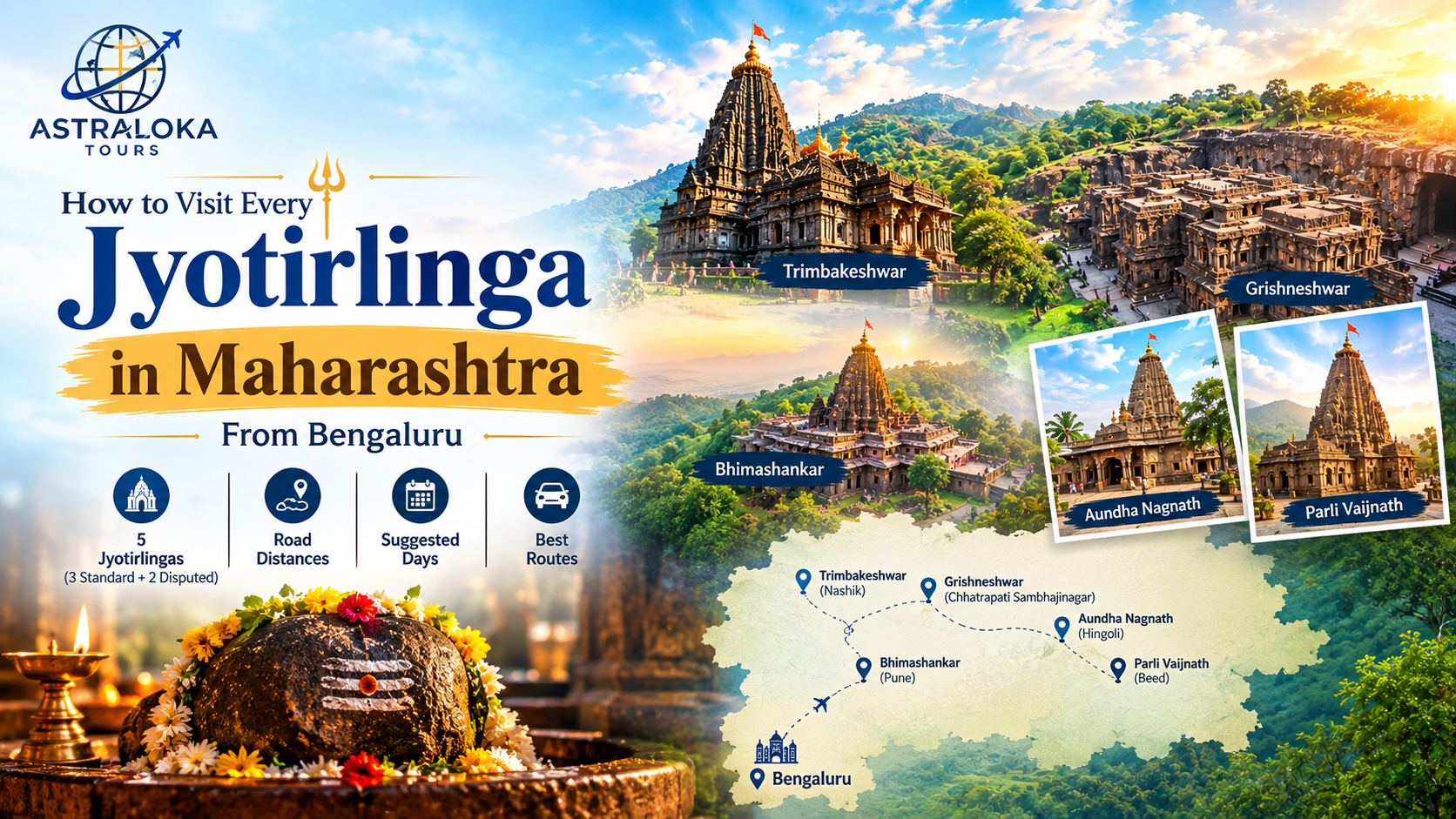
Maharashtra has three jyotirlingas on the standard list and two more that local tradition adds. See where each jyotirlinga in Maharashtra sits, how far apart they are, and how a Bengaluru pilgrim covers three in three days or all five in five.
Many Bengaluru pilgrims plan Maharashtra around Shirdi, then find that the Shiva shrines they want to add sit hours apart on very different roads. If Sai Baba darshan anchors your trip, our Shirdi Sai Baba travel guide covers the aarti clock first.
This guide maps every jyotirlinga in Maharashtra: the three on the standard list, the two that are disputed, the real road distances between them, and the number of days each route takes.
The standard list places three jyotirlingas in Maharashtra: Trimbakeshwar near Nashik, Grishneshwar beside the Ellora Caves, and Bhimashankar in the Sahyadri hills north-west of Pune. Two more, Aundha Nagnath and Parli Vaijnath, are also claimed, which is why many pilgrims and local guides count five.
A jyotirlinga is a shrine where Shiva is believed to have appeared as an endless pillar of light, and the Shiva Purana names twelve of them across India.
The dispute comes from the Dwadasha Jyotirlinga Stotram, the short hymn that lists the twelve. It describes each location poetically rather than precisely, so more than one temple reads its line as its own.
So when someone asks how many jyotirlingas are in Maharashtra, three and five are both defensible answers. The count matters less than the map, because the disputed pair sits well over 200 km east of Grishneshwar, in Marathwada.
The jyotirlinga temples in Maharashtra fall into three clusters. Trimbakeshwar and Grishneshwar sit within about 125 km of Shirdi, Bhimashankar is a hill drive from Pune, and the disputed pair of Aundha Nagnath and Parli Vaijnath lie about 118 km apart in Marathwada.
| Temple | District | Reach it from | Road distance | What stands out |
|---|---|---|---|---|
| Trimbakeshwar | Nashik | Shirdi | 110 to 125 km | A hollow linga with three small faces, near the source of the Godavari |
| Grishneshwar | Chhatrapati Sambhajinagar | Shirdi | About 95 km | Counted as the twelfth jyotirlinga, about a kilometre from Ellora |
| Bhimashankar | Pune | Pune | About 110 km | Inside a wildlife sanctuary, where the Bhima river rises |
| Aundha Nagnath | Hingoli | Grishneshwar | About 227 km | The sanctum sits below ground level, down a few steps |
| Parli Vaijnath | Beed | Aundha Nagnath | About 118 km | Devotees may touch the linga during darshan |
Road time sets the pace more than distance does. Bhimashankar is the slowest jyotirlinga in Maharashtra to reach per kilometre, because the last stretch climbs ghat roads through the sanctuary, and the 110 km from Pune takes three to three and a half hours.
Short on time? Bhimashankar and Grishneshwar pair well with Shirdi, which is how our Shirdi with 2 Jyotirlinga trip fits both into a single night, flying in and out of Pune.
Fly into Pune, visit Bhimashankar on the way to Shirdi, give Trimbakeshwar its own day via Nashik, and pair Grishneshwar with Ellora on the way back. This loop covers the three main shrines plus Sai Baba darshan in two nights, with Shirdi as your base.
Day one is the long one, close to 285 km, including the ghat road up to Bhimashankar and back down. Take the earliest flight you can, carry snacks for the ghat, and treat the Shirdi check-in as the only fixed point of the evening.
Day two is the most flexible. Trimbakeshwar queues are shortest early on weekdays, so the Nashik temples and the ghats work better after darshan than before it.
On day three, fit Ellora inside its 9 am to 5 pm hours, since Grishneshwar stays open well into the evening. At the caves, give most of your time to Cave 16, the Kailasa temple, a Shiva shrine carved out of a single rock.
A Maharashtra jyotirlinga tour package built on this loop takes the driving off your hands. Our Shirdi with 3 Jyotirlinga itinerary follows this order, with Bhimashankar on day one and Grishneshwar on the way home.
Choose three if this is your first trip or you travel with elders, and all five if completing the count matters to you. The full circuit adds Aundha Nagnath and Parli Vaijnath, at least 345 km of extra driving through Marathwada, and two more days.
| Route | Temples | Days | Best for |
|---|---|---|---|
| Two-temple trip | Bhimashankar and Grishneshwar | 2 | A long weekend built around Shirdi |
| The standard three | Bhimashankar, Trimbakeshwar, and Grishneshwar | 3 | First visits, families, and seniors |
| Three plus Ajanta | The standard three and the Ajanta Caves | 4 | Pilgrims who want heritage as well |
| Full five | The standard three, Aundha Nagnath, and Parli Vaijnath | 5 | Devotees completing the Maharashtra count |
If you want to see each jyotirlinga in Maharashtra in one trip, plan a four-night, five-day loop. Sequence Aundha and Parli after Grishneshwar, since both lie east of it, and plan the final day around the long drive back to an airport.
Aundha rewards the extra distance. Tradition holds that the temple turned to face the poet-saint Namdev after he was refused entry because of his caste, which is why worshippers now enter from what was once the back of the temple.
Each shrine runs its own system. Trimbakeshwar sells a ₹200 donation darshan pass, Grishneshwar asks men to enter the sanctum bare-chested, and Bhimashankar has used online darshan passes since it reopened in June 2026.
Dress modestly at any jyotirlinga in Maharashtra. A saree or salwar kameez works for women, a dhoti or plain trousers for men, and shorts or sleeveless tops are discouraged at the sanctum door.
October to February is the easiest window, because the Deccan is dry and mild and the Bhimashankar ghat is safer. Monsoon turns the Sahyadris green but slippery, while Mondays, Shravan, and Mahashivratri bring the longest queues at the major temples.
The year 2027 needs its own plan. The Simhastha Kumbh Mela at Nashik and Trimbakeshwar formally opens on 31 October 2026 and runs until July 2028, with the main bathing days falling in August and September 2027.
Expect Trimbakeshwar at its most crowded around those bathing days, with road restrictions near the town. Pune’s district administration also expects Bhimashankar’s footfall to approach one lakh a day during the Kumbh, which is why a new sabhamandap and stairway are part of its redevelopment.
Summer is the season to avoid for the full circuit. Marathwada gets very hot from April, and the long road days to Aundha and Parli become tiring for older travellers.
Decide the count first, then work backwards: choose an airport, sequence the temples by road, and book darshan passes before hotels. For the three-temple loop, Pune is the most practical gateway from Bengaluru, because Bhimashankar sits on the first day’s drive.
If you have a fourth day, Ajanta’s painted caves make a strong finish, which is how our Shirdi with Ajanta and 3 Jyotirlinga tour ends before the flight home.
Start with the three main shrines if this is your first visit, and add Aundha and Parli when completing the count matters. Browse our Maharashtra tour packages, or share your dates, and we will plan each jyotirlinga in Maharashtra you want to see around your flights and darshan passes.
Everything you need to know before you travel with Astraloka Tours.
Grishneshwar is the closest, about 95 km away beside the Ellora Caves. Trimbakeshwar is roughly 110 to 125 km from Shirdi, and Bhimashankar about 175 km.
It is one of three temples claiming the Nageshwar jyotirlinga, alongside Dwarka in Gujarat and Jageshwar in Uttarakhand. Tradition in Maharashtra counts it, while the standard list names Dwarka.
Allow five days to see each jyotirlinga in Maharashtra, including Aundha Nagnath and Parli Vaijnath. The three main shrines fit comfortably into three days from Pune or Shirdi.
Modest traditional wear such as a saree or salwar kameez is expected. Shorts and sleeveless tops are discouraged, especially at Trimbakeshwar and Grishneshwar.
Since it reopened in June 2026, Bhimashankar has run darshan through online registration with a daily cap. Book through the temple trust’s website before you drive up from Pune.
Yes, with pacing. At Bhimashankar the temple sits below the parking area, down a flight of steps, so plan assistance there and avoid the Monday crowds.
Travel Guide
Plan your Meghalaya trip cost from Bangalore with a 5-day itinerary covering flights, stays, meals and transfers. Explore the full itinerary and enquire today.
Read Article Pilgrimage
lan the Vaishno Devi Amritsar tour package from Bangalore: 3 nights, flights, pure-veg meals and a day-wise itinerary. Check the details and enquire today.
Read Article Travel Guide
Work out your Puri Jagannath trip cost from Bangalore: flights, stays, cabs and tickets, with DIY totals beside our 2N/3D package from ₹31,999. See the numbers.
Read ArticleShare your travel dreams with us and we'll turn them into a perfectly planned journey.
Share your details & our travel expert will call you back within 24 hours.